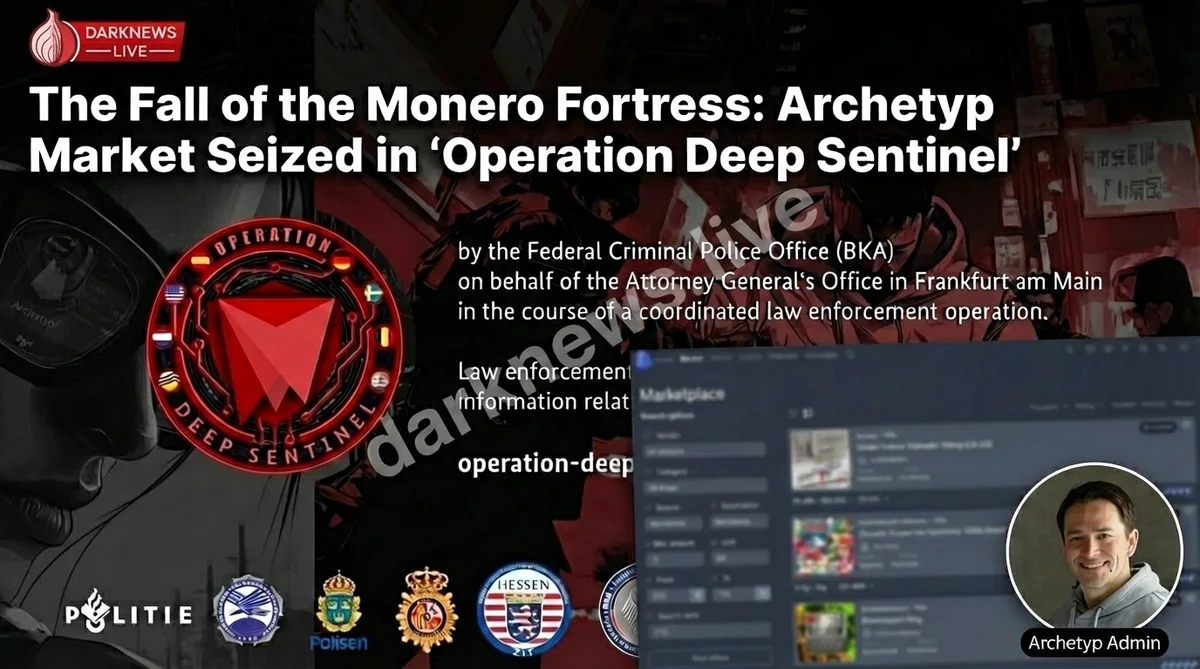
The Fall of the Monero Fortress: Anatomy of the Archetyp Market Seizure
The King is Dead
For five years, Archetyp Market stood as the impregnable fortress of the darknet economy. Launched in May 2020 amidst the chaos of the Empire Market exit scam, it distinguished itself with a philosophy of 'Technical Minimalism'—no Bitcoin, no fancy graphics, just Monero (XMR) and speed. It survived the storms that sank its contemporaries, largely due to this strict crypto-hygiene.
That legacy ended abruptly on the morning of June 17, 2025. Visitors to the familiar onion address were not greeted by the login prompt, but by the now-infamous 'THIS HIDDEN SERVICE HAS BEEN SEIZED' splash page, featuring the animated badges of 'Operation Deep Sentinel'—a joint task force led by the German Federal Criminal Police Office (BKA), supported by the FBI, Europol, and Dutch National Police.
Phase 1: The Decapitation Strike
The most significant blow was the physical capture of the market's architect. On June 11, 2025—six days before the public seizure banner went live—authorities in Barcelona, Spain, arrested 30-year-old German national Marc Hegemeister, known to the world as the admin 'ASNT'.
Contrary to rumors of a US-style 'life without parole' sentence, Hegemeister is facing prosecution under strict German narcotics and money laundering laws. Based on the precedents set by the *WallStreet Market* and *Cyberbunker* trials, he faces a likely maximum of 15 years in prison. However, the seizure of €8 million in server-side assets and keys to wallets containing potentially €250 million makes this one of the most lucrative seizures in EU history.
The OpSec Failure: Parallel Construction
How do you find a ghost? You don't break Tor; you look for human error. Analysts believe law enforcement employed Parallel Construction. Intelligence agencies (like the NSA or GCHQ) likely identified Hegemeister via traffic correlation or a VPN leak years ago, but this data is inadmissible in court.
To build a legal case, the BKA likely worked backward from his physical life: auditing his lavish spending in Barcelona, tracing 'cleaned' crypto that eventually hit a KYC off-ramp, or exploiting a zero-day vulnerability in the server's SSH configuration. Once they had a suspect, physical surveillance confirmed his patterns, allowing them to time the arrest while he was logged into the admin panel.
Phase 2: The 'Honeypot' and Vendor Raids
Operation Deep Sentinel arrested six high-volume vendors in Germany, Sweden, and the Netherlands within hours of the public seizure. This synchronization is technically impossible via standard forensic analysis of a 'cold' (encrypted) server seized that same morning. It strongly implies a Honeypot Operation similar to the Hansa Market takedown of 2017.
Tor Deanonymization: The Packet Timing Attack
A common misconception is that Tor completely hides your activity from a global adversary. While Tor encrypts the *content*, it cannot fully hide the *timing* and *volume* of data.
Investigators likely used Traffic Confirmation Attacks. By controlling the market server (the 'End'), they knew exactly when they sent a specific 50KB confirmation page to a user. Simultaneously, by monitoring metadata at major ISP exchange points (the 'Start'), they scanned for an encrypted connection that received a burst of packets matching that exact size and timing. Even with Tor's padding, enough correlation points over time can statistically identify a user's home connection with high probability.
The Postal Vector
Digital evidence was likely secondary to physical surveillance. The investigation reportedly utilized Postal Interdiction AI. By analyzing handwriting styles, packaging materials, and drop-off times at mailboxes across Europe, authorities linked digital vendor profiles to physical locations. Once a suspect was identified dropping off packages, cameras were installed to capture them accessing the market on their mobile devices.
The Fatal Error: PGP Laziness & RAM Scraping
The most damning evidence found on the seized servers wasn't metadata—it was Cleartext Data. The scale of the arrests highlights a critical failure on the user side: The abandonment of manual PGP encryption.
The 'Auto-Encrypt' Trap
Many users relied on the market's 'Auto-Encrypt' feature for convenience. This is a fatal error. When you check that box, you are sending your address in Cleartext to the server, trusting the server to encrypt it for the vendor.
If the BKA had root access to the server for weeks prior to the takedown (the Honeypot phase), they likely installed a RAM Scraper. This script captures data the split-second it arrives in the server's ephemeral memory (RAM), *before* it gets encrypted and stored in the SQL database. This means every 'Auto-Encrypted' order placed during the investigation period was captured by police in plain text.
The Lesson: Tor protects the transport. Monero protects the money. Only PGP protects the message. If you did not encrypt locally on your own device, your address is likely in a BKA dossier right now.
Market Impact: The End of an Era
Archetyp was the last of the 'Titans'—the centralized, monolithic markets that dominated the landscape. Its fall proves that no amount of code can fix human error or physical centralization. The server must exist *somewhere*, and that physical location (in this case, a data center in the Netherlands) is always the weak point.
The ecosystem is now fracturing. We are seeing a mass migration away from web-based markets toward decentralized protocols, Telegram bots (which have their own severe security risks), and private vendor shops that limit the 'blast radius' of a single seizure. The era of the 'Super Market' likely died with Archetyp.
The Final Verdict
The fall of Archetyp is not a failure of encryption, but a failure of operational security and centralization. It serves as a stark reminder that in the digital underground, convenience is the enemy of security.
Discussion 1
Leave a Reply