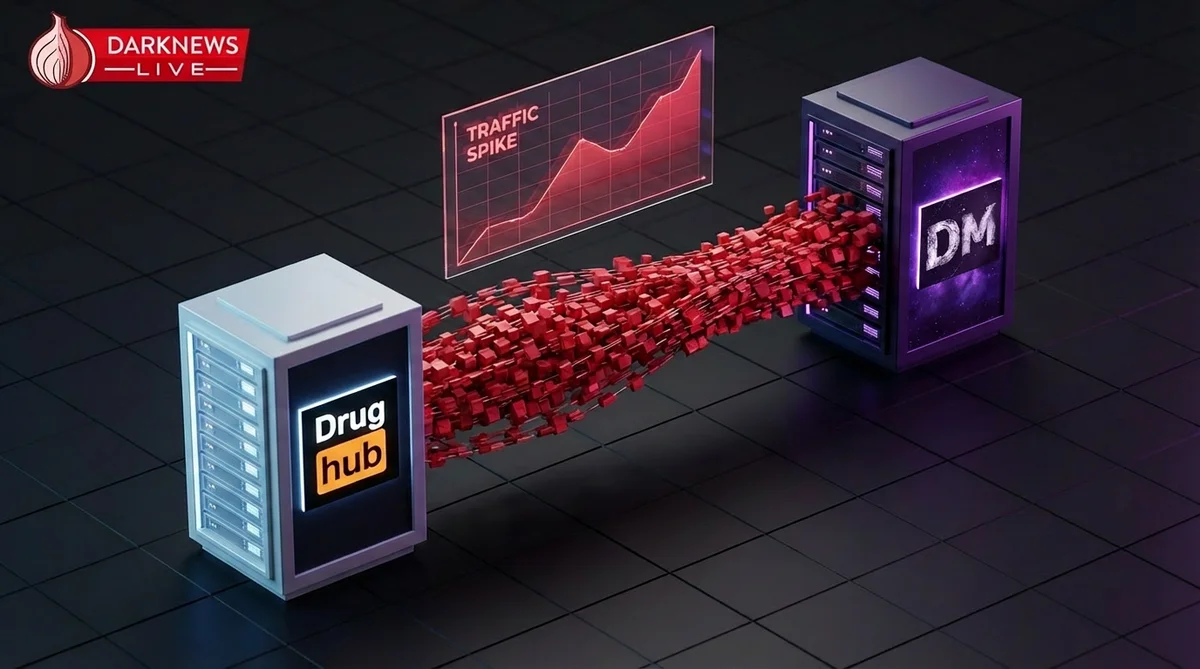
Total War: DrugHub, Dark Matter, and the Weaponization of Traffic
The Ecosystem is Burning
Stability on the Tor network has become a relic of the past. For the last month, the major pillars of the darknet economy—TorZon, Black Ops, and the warring titans DrugHub and Dark Matter—have faced unprecedented downtime. While novice users speculate about FBI raids or Tor network bugs, the reality is far more cynical. The darknet has entered a phase of Total War, where traffic is weaponized not just to disrupt service, but to destroy competition and, inadvertently, expose administrators to the state.
The DrugHub Confession: 'Digital Darwinism'
In a move that shocked the community, the administrator of DrugHub (/u/DrugHub) took to Dread to publicly claim responsibility for attacks on rival markets. Abandoning the old-school ethos of 'honor among thieves,' the admin framed the attacks as a necessary evolution of the marketplace.
The Walmart Doctrine
In a heated exchange with community member /u/TeachUHow2Trap, DrugHub explicitly compared their tactics to corporate warfare: 'If Wal-Mart could legally DDOS Target's website during Black Friday, would they have?' The admin confirmed, 'Some markets are ddosed by me. Others like ourselves are ddosed by another asshole.' This marks a shift toward 'Digital Darwinism'—where the ability to sustain and inflict server costs is the only metric of survival.
The Extortion Bid
DrugHub went further, proposing a 'settlement' to end the hostility: rival markets must pay a compensation fee, split between Dread donations and harm reduction charities. While some users praised the 'Robin Hood' aspect of donating the extortion money, the underlying reality remains: this is a protection racket operating at the protocol level.
The Technical Arms Race: PoW vs. EndGame
The conflict has exposed the severe limitations of current Tor defenses. The battle is currently being fought between two technologies: Tor's Native Proof-of-Work (PoW) and the private EndGame solution developed by Dread admin Paris.
Why Tor PoW is Failing
Tor introduced PoW (in version 0.4.8) to force clients to solve a computational puzzle before connecting, theoretically making DDoS expensive for the attacker. However, botnets like AISURU (referenced in Cloudflare reports) have simply scaled up their CPU power. As Paris noted on Dread: 'Tor's PoW protects against a single powerful kind of attack called [Introduction Cell] attacks. It doesn't protect against mass load attacks.'
The EndGame Solution
To survive, markets like TorZon and Archetyp (prior to its seizure) utilized EndGame. This system uses Onionbalance to distribute traffic across dozens of 'front-end' proxies. If a front-end is overwhelmed, it is burned and replaced, shielding the actual backend server containing the database. The controversy now centers on 'GoBalance,' a rumored hybrid system that combines PoW with load balancing—a 'holy grail' tech that currently commands a $10,000 bounty for a stable implementation.
The Fatal Risk: DDoS as a De-anonymization Vector
While markets view DDoS as a business cost, Law Enforcement Agencies (LEA) view it as an opportunity. A sustained, high-bandwidth attack is one of the most effective ways to locate a physical server hidden behind Tor. This is the aspect of the 'DDoS War' that should terrify every admin involved.
Traffic Correlation Attacks
Tor anonymizes traffic by bouncing it through three nodes. However, physics cannot be cheated. If an attacker (or LEA) pushes 10 Gbps of traffic into the Tor network destined for DrugHub, that same 10 Gbps must exit the Tor network and enter a physical data center somewhere in the world. By monitoring traffic spikes at major ISPs in favorable jurisdictions (like the Netherlands, Germany, or Finland), LEA can correlate the entry time and volume with the exit time and volume. A market under heavy DDoS lights up on an ISP's dashboard like a flare in the night sky.
Guard Node Exhaustion
Hidden services utilize a specific entry point known as a Guard Node. A stable market keeps its Guard Node for months to prevent 'Sybil Attacks' (where LEA floods the network with malicious nodes). However, a successful DDoS often forces a market to reboot or rotate its Guard Nodes frequently to escape the flood. This 'churn' vastly increases the statistical probability that the market will eventually pick a malicious Guard Node controlled by the NSA or BKA. Once the Guard Node is compromised, the true IP address of the market is exposed.
Collateral Damage: The Phishing Epidemic
As the giants fight, the parasites feast. The instability of main `.onion` addresses has driven users to 'link aggregators' to find working mirrors. Intelligence suggests that Dark Matter affiliates may be exploiting this via the site DNF.fail (a clone of the defunct darknet.fail). Users report that during DDoS downtime, these aggregators push phishing links that steal credentials. Black Ops and TorZon have countered this by pushing signed 'rotating mirrors' to trusted sites like Tor.Run and Tor.watch, but the risk remains high. If you cannot verify the PGP signature, you are walking into a trap.
Analyst's Conclusion
The DDoS War of 2025 is a suicidal endeavor. By engaging in massive volumetric attacks, DrugHub and Dark Matter are generating the exact kind of network noise that allows global intelligence agencies to pinpoint their data centers. The winner of this war won't be the market with the best botnet; it will be the market that doesn't get raided because their rival was too busy being loud.
Discussion 4
Leave a Reply