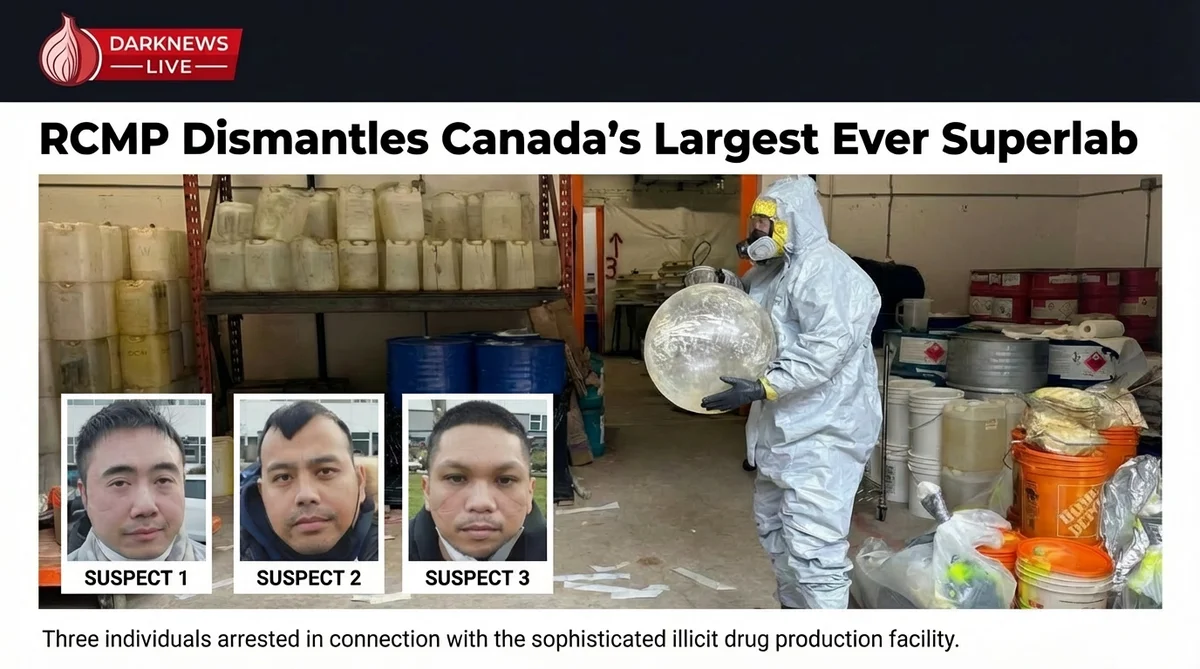
RCMP Dismantles Canada's Largest Ever Superlab
Industrial Scale Failure
On October 25, the Royal Canadian Mounted Police (RCMP) executed a series of coordinated raids that effectively wiped a major transnational node off the map. This wasn't a standard knock-and-talk; this was a federal-level dismantling of the largest, most sophisticated drug superlab in Canadian history. The primary target was a remote property in Falkland, British Columbia—a quiet community of less than 900 people that was unknowingly hosting a factory capable of poisoning the entire population of the country twice over.
The Logistics of the Bust
Federal Policing investigators from the Pacific Region, supported by the Clandestine Laboratory Enforcement and Response (CLEAR) team, executed search warrants not just in Falkland, but across associated stash houses in the Surrey area of Metro Vancouver. The operation revealed a staggering level of infrastructure. We aren't talking about bathtub chemistry here; the facility was engineered for mass production, utilizing the complex Phenyl-2-Propanone (P2P) method typically associated with the Mexican super-cartels. This indicates a level of chemical expertise and supply chain maturity that is rarely seen north of the US border.
The Inventory: A Market-Moving Event
The numbers coming out of the seizure logs are enough to rattle the domestic market for months. Investigators seized 54 kilograms of fentanyl—massive by any standard—along with 390 kilograms of methamphetamine. To put that in perspective, the RCMP estimates the fentanyl alone represents 95,000,000 potentially lethal doses. They also confiscated significant quantities of precursor chemicals, 35kg of cocaine, and 15kg of MDMA. For the organization moving this product, this isn't just a loss of inventory; it represents tens of millions in lost revenue and a catastrophic disruption of their Q4 distribution capabilities.
The Armory: A Paramilitary Outpost
What separates this bust from a standard lab raid is the kinetic capability protecting it. The RCMP recovered an arsenal of 89 firearms, including AR-15-style rifles, submachine guns, and handguns—nine of which were confirmed stolen. This wasn't just for protection; this was an offensive stockpile. The seizure included silencers, high-capacity magazines, body armor, and small explosive devices. They were prepared for a war, likely against rival factions, but you can't shoot your way out of a federal indictment.
Hazardous Waste and Environmental Blowback
One of the critical OpSec failures of superlabs is the waste footprint. Manufacturing nearly half a ton of meth creates tonnes of toxic sludge. The cleanup of the Falkland site alone is costing the taxpayer nearly $500,000 CAD. In our line of work, waste management is usually what gets you caught. You can hide the money, you can encrypt the comms, but you cannot hide thousands of liters of chemical runoff forever. The environmental impact is often the breadcrumb trail that leads the CLEAR teams right to the front door.
The Human Element and Transnational Ties
While the physical infrastructure is gone, the intelligence fallout is just beginning. Police arrested Gaganpreet Randhawa, who now faces a laundry list of drug and firearms charges. With $500,000 CAD (approx. $360,000 USD) in cash seized, the financial trail is fresh. Randhawa is currently the primary suspect in custody, but the RCMP's Assistant Commissioner David Teboul has explicitly linked this operation to transnational organized crime. The sheer volume of precursors suggests a logistics network capable of importing raw materials from overseas, likely Asia, and moving finished product across international borders.
The Ripple Effect
In this line of work, a suspect in custody is a liability to everyone in their contact list. If Randhawa cooperates, or if his devices were seized unlocked, the downstream ripples will hit associates from Vancouver to the international buyers this lab was servicing. The seizure of the Surrey locations suggests the feds already had the distribution network mapped out before they kicked down the door in Falkland.
Admin's Insight: The Hubris of Centralization
This bust reinforces the oldest rule in the book: Don't get greedy. By concentrating this much production and firepower in a single static location—the 'Superlab' model—this crew created a single point of failure. They built a fortress in a small town, assuming remoteness equaled invisibility. It does not. Sophisticated ventilation and remote locations can't hide the logistics of industrial chemical delivery forever. The RCMP didn't just find drugs; they found a centralized weakness. Expect a pivot back to smaller, decentralized 'ghost labs' as the syndicates lick their wounds. The era of the static Superlab is ending; mobility and decentralization are the only survival strategies left.
Discussion 0
Leave a Reply